
Continuing professional development
Your learners answer to a board. Give them the record.
Pharmacists, nurses, agents and licensed practitioners have to keep earning credit every year and prove it. Price your activities in the credit their board counts, print it on the certificate, and hand them a statement for the cycle.
Included on every plan, including the free one · Off until you turn it on
How it works
Describe, price, issue, prove.
Four steps, and three of them are things you already do. The credit rides the completion document you were issuing anyway.
01
Describe the scheme
The board or licence rule you track against: the word it counts in, the dates each cycle runs between, and how much a learner needs.
02
Price your activities
Rate each course in that credit. Enter the hours and the per-hour rate and the credit works itself out, so an auditor asking how six credits were reached can be shown the working.
03
Deliver and issue
Run the activity the way you already do. When the completion document is issued, the credit is written onto it along with the activity accreditation number.
04
Show them where they stand
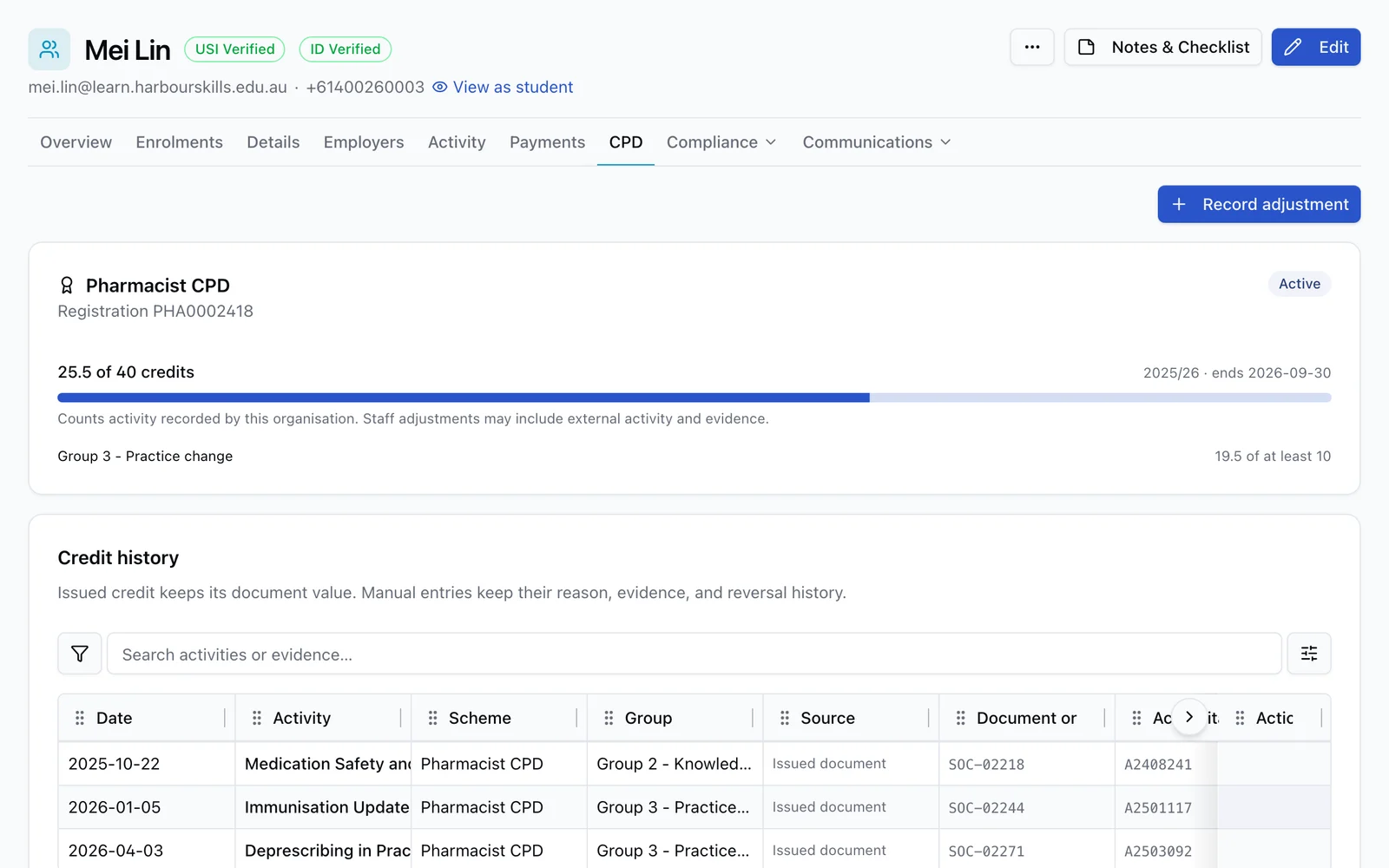
Registered learners see their position in the current cycle and download a statement. Your staff see the same figures against the learner record.
What you get
Built for how boards actually write the rules.
Not every scheme counts hours, and almost none of them count a single flat total. The model follows the rules rather than the other way round.
Your board’s words, not ours
Hours, points, credits or activities. Dated cycles you write, so a boundary cannot drift and correcting a setting later cannot move credit between years.
Four credit units · Written cycle dates · No overlapping periods · No pre-filled schemes
Requirements with floors and ceilings
A total for the cycle, plus minimums and maximums per category. "40 credits, at most 20 from Group 1, at least 20 from Group 2" is three rules.
Period totals · Category minimums · Category ceilings · Earned and counted shown apart
Credit frozen at issue
The value, its arithmetic, the scheme name and the accreditation number are written onto the completion document and never recalculated.
Re-pricing affects future issues only · Reprints match the original · Voids remove withdrawn credit
Accredited and non-accredited alike
A recognised skill set can earn CPD and a Statement of Attainment at once. Non-accredited activities stay out of your AVETMISS submission and issue a Statement of Completion.
One learner record · AVETMISS untouched · USI and LLN gates unchanged
Straight talk
We record what you delivered.
RTObase holds the credit your RTO issued. Activity a learner did somewhere else, a conference, a journal article, a course with another provider, is not in here yet, so the statement is a record of their training with you rather than a complete return to their board. Most boards ask the professional to keep their own log, so for most providers that is the right division of labour. If you need to hold the whole record, tell us before you commit.
One thing we are strict about: the credit written on a certificate never changes afterwards. Re-price an activity and only future issues move. It is a small decision that matters the day a board asks a learner to substantiate something they did three years ago.
Delivering nationally recognised training as well? See the rest of the platform, or what it costs.
Questions
CPD, answered.
Any scheme you can describe as an amount of credit inside a recurring cycle. You set the word it counts in (hours, points, credits or activities), the dates the cycle runs between, and the amount required. Pharmacy counts credits in a year running 1 October to 30 September; nursing counts hours; several property and building regulators count points. RTObase ships no pre-filled schemes, because the numbers change and a wrong default in a compliance product is worse than no default.
Yes, and it often does. A nationally recognised immunisation skill set is AVETMISS reported, needs a verified USI and is marked competent or not yet competent, and it also earns CPD credit. You can price any course, accredited or not.
Only documents issued from that point on use the new value. The credit is written onto each completion document when it is issued and is never recalculated, so a statement a learner is already holding never changes. If a board audits that learner in three years, their copy and yours still agree.
Registered learners see their position in the current cycle in the student portal and can download a CPD statement for the period. Their certificates carry the credit and the activity accreditation number, which is what they quote in their own log.
Learners cannot add activity themselves. An administrator can record an external activity as a signed adjustment when the RTO has checked the evidence. The statement separates those adjustments from completion documents issued by your RTO.
Every plan, including the free Startup plan. CPD tracking is switched on per organisation in Settings and is off by default, so RTOs whose learners do not report to a board never see it.
Track the credit your learners actually need.
Free to start, and off until you turn it on.